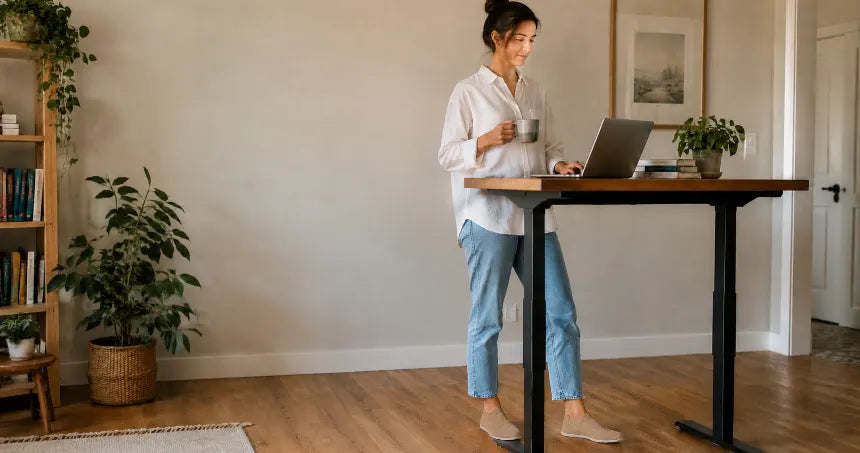
There’s no single right answer, but there’s a good case for wearing a clean, dedicated pair of shoes at home rather than going barefoot or in socks all day, especially on hard floors and stairs. The trick is to keep your street shoes at the door and wear something that’s comfortable, stays on your heel, and can be washed.
Few household questions start arguments quite like this one. Some homes are strictly shoes-off at the door. Some have never thought about it. And then there’s everyone who now works from home and has quietly realized they spend more hours in their house than anywhere else, mostly in socks. If that’s you, here’s what’s worth knowing.
Why do people take their shoes off at home?
Mostly to keep the outside out. The bottoms of shoes pick up whatever’s on the ground. A review of 13 studies, most of them in hospitals, found shoe soles can carry bacteria such as MRSA and C. difficile from one place to another.1 Your sidewalk isn’t a hospital floor, but the instinct to leave street shoes at the door is a sensible one.
Comfort is the other reason. Most outdoor shoes feel heavy and stiff after a few hours, and kicking them off at the door feels great. Nobody is arguing you should wear your commute shoes on the couch.
So why wear shoes inside at all?
Because socks and bare feet have their own problems, especially on the hard floors most of us have now.
- Socks are slippery. Socks on hardwood, tile and stairs are an easy way to slip. Research on older adults is striking: in one study, going barefoot or in socks indoors was linked with a much higher chance of a fall at home,2 and in another, about half of all falls at home happened while people were barefoot, in socks or in slippers, even though few people usually wore those.3 These studies are about adults over 60 and show a link rather than proof, but the researchers’ advice was the same: wear proper shoes at home.
- Floors are hard. Eight hours on hardwood or tile with nothing underfoot is a different day from eight hours with a footbed and some arch support.
- The day keeps going outside. If you work from home, you’re in and out all day. Socks don’t work on the driveway.


What about slippers?
Slippers are lovely for an evening on the couch. They’re less good as all-day shoes. Backless ones slide around and can come off on the stairs. The CDC’s fall-prevention guide for older adults recommends properly fitted shoes with good traction, worn inside the home as well as outside.4 And most slippers can’t go outside without getting soaked or ruined, so you end up switching shoes every time you leave the house.
The middle ground: a clean pair just for home
What works for most people is simple. Street shoes stay at the door. A separate, comfortable pair lives inside. The best version of that indoor pair:
- stays on your heel, so it’s secure on stairs;
- has a sole with grip, not a smooth felt bottom;
- has some shape and arch support underfoot;
- slips on without laces;
- can step outside for the mailbox without being ruined;
- can be washed when it does get dirty.
That list is more or less why COOPS exist. They’re a knit sock shoe with a contoured footbed, built-in arch support and a real rubber outsole, and the whole pair goes in the washing machine. They’re a casual everyday shoe, not a medical or fall-prevention device, so if you or someone you’re buying for has balance or foot concerns, ask a doctor or podiatrist what’s right.

How to set up a shoes-at-home routine
- Make a shoe spot by the door. A tray or rack where street shoes live. If it’s easy, it happens.
- Keep the home pair next to it. Swap as you come in.
- Decide your rule for quick trips. An easy one: the home pair can go to the mailbox, the garden and the dog walk, and if they get muddy, they get washed.
- Wash on a schedule. Every few weeks, or when they need it. Here’s how to wash COOPS.
- Have spares for guests if you’re strict. Some households keep a basket of clean house shoes or socks for visitors.
What if you work from home?
Then this matters more, because home is where you spend the workday too. A pair that’s comfortable at the desk, quiet on calls and ready for the coffee run makes the whole day easier. We wrote a full guide to the best shoes for working from home, and our indoor-outdoor house shoes page shows how people wear COOPS around the house and yard.