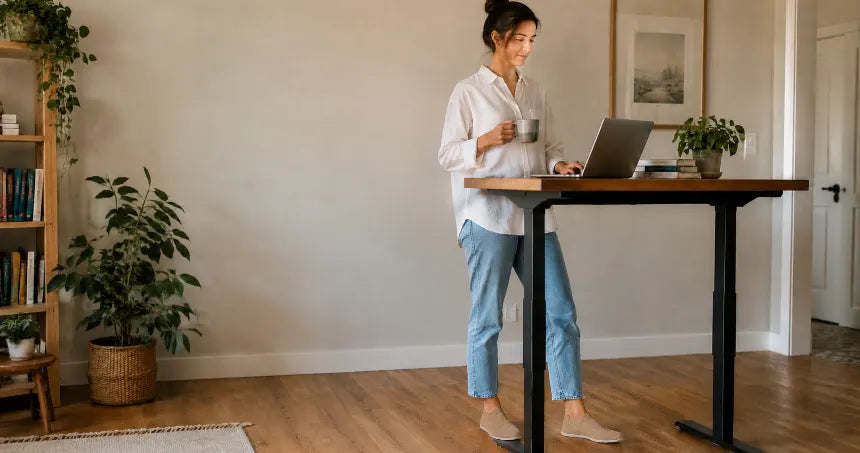
The best shoes for working from home are soft enough to forget about at your desk, quiet on hard floors, easy to slip on and off, and have a real outsole so you can step outside without changing. Slippers fail the last test, sneakers fail the first. A knit sock shoe with a rubber sole, like COOPS, covers the whole day.
COOPS started with working from home. Socks were perfect at home, shoes were better outside, and we wanted one pair that did both. Eighteen prototypes later, that became COOPS. This post is what we’ve learned since about what to wear on your feet when your office is your house, and what to look for even if you never buy a pair from us.
Do you actually need shoes to work from home?
You don’t need them. Plenty of people work in socks and are perfectly happy. But a lot of us are now doing this every day: according to the US Bureau of Labor Statistics, about a third of employed Americans do some of their work at home on the days they work, and among people with a college degree it’s half.1 When it’s every day rather than an occasional Friday, small things add up.
Here’s what changes when you swap socks or slippers for a real pair at home:
- Feet feel better at the end of the day. Hard floors are hard. A shoe with a footbed and some arch support is kinder over eight hours than a sock on hardwood.
- The workday feels like a workday. Putting shoes on is a small signal that you’re on. Taking them off at the end is a signal that you’re done.
- You stop changing shoes ten times a day. Mailbox, dog, coffee run, parcel at the door. If what’s on your feet works outside, you just go.
What makes a good work-from-home shoe?
1. Comfortable enough to forget about
You’ll wear these for nine or ten hours. Anything stiff, heavy or tight will remind you it’s there by mid-afternoon. Look for a flexible upper that moves with your foot, and a footbed with some shape to it rather than a flat insole.
2. Quiet on hard floors
Hard soles clack on hardwood and tile, which you notice on calls and so does everyone downstairs. A soft knit upper and a rubber outsole are close to silent.
3. Easy on and off
No laces. You want to step into them when you get up and kick them off on the couch at the end of the day without bending down.
4. A real outsole
This is the one most house shoes skip. Working from home involves a surprising amount of outside: the porch, the driveway, the walk to get lunch, the school pickup. A rubber sole with tread means you don’t need a second pair by the door.
5. Washable
If they go outside, they get dirty, and then they come back in and walk across your rug. Being able to put the whole pair in the washing machine solves that. Here’s how to wash COOPS.


Slippers, sneakers or sock shoes?
| Slippers | Sneakers | COOPS sock shoes | |
|---|---|---|---|
| All-day comfort at a desk | Good | Fine, but heavier | Good |
| Quiet on hardwood | Yes | Often not | Yes |
| Slip on, no laces | Yes | Usually not | Yes |
| Step outside | Not really | Yes | Yes, rubber outsole |
| Machine washable | Some | Rarely | Yes, the whole shoe |
| Stays on your heel | Backless ones don’t | Yes | Yes |
We’re biased, obviously. But the point stands even if you don’t buy COOPS: pick something that does both inside and outside, because your workday does both.
Does working from home mean more sitting?
It can. A survey of over 2,000 American adults early in the pandemic found that people who had started working from home reported a bit more sitting and screen time than those whose work hadn’t changed.2 A smaller Swedish study that measured office workers with activity trackers found their sitting and moving didn’t change much on home days,3 so it depends a lot on how you set your day up.
The World Health Organization’s advice is simple: limit the time you spend sitting, and replace some of it with movement of any kind.4 At home that’s easier than in an office if you build it in. Take calls standing. Walk to the mailbox between meetings. Do the coffee run on foot. All of which is easier when you’re already wearing shoes you can walk out the door in.

High Top or Low Top for working from home?
Both have the same sole, footbed and fit. The Low Top sits below the ankle and is the easiest to slip on and off, which suits a desk day. The High Top covers the ankle and feels a bit cozier, nice in a cold house or in winter. Can’t decide? Get one of each; two pairs are US$60 each.
What our remote-working customers say
“No clacking on the hardwood, so I can move around during calls without muting myself.”
A COOPS customer
“Remote job, so I’m at my desk then out with the dog twice a day. I stopped swapping shoes entirely.”
A COOPS customer
If you want to see more of how people wear them through a home workday, our work-from-home page has the full picture, and we wrote about standing desks and whether to wear shoes in the house too.