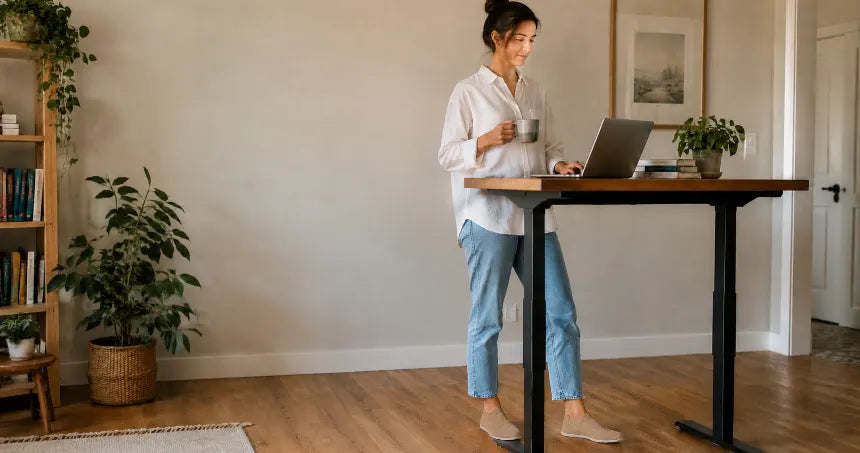
At a standing desk, wear shoes with a supportive footbed and room for your toes, and stand on a cushioned mat if the floor is hard. Then don’t stand all day either: switching between sitting, standing and walking matters more than any shoe. Barefoot or socks on a hard floor is the least comfortable option for long stretches.
A standing desk is one of those purchases that feels great for a week. Then around day eight you notice your feet ache by three o’clock and you’re back in the chair with the desk stuck halfway up. If that sounds familiar, the desk isn’t the problem. How long you stand, and what’s under your feet while you do, probably is.
Do standing desks actually help?
They do one thing reliably: they cut down sitting. A Cochrane review, which is about as careful as health research summaries get, found sit-stand desks reduced sitting at work by roughly an hour and a half a day in the first few months, and by around an hour over the following year. The evidence was low certainty and there isn’t much long-term data on health effects.1 A separate review found sit-stand desks may slightly reduce low-back discomfort.2
So: useful, not magic. The benefit comes from moving between positions, not from standing instead of sitting.
Is standing all day bad for you?
Standing for long stretches has its own costs. A review by researchers at NIOSH, the US occupational safety agency, linked prolonged standing at work with low back and leg pain, fatigue and general discomfort, and the common thread in what helped was changing posture regularly.3 Lab studies have found back discomfort tends to show up after somewhere around 40 to 70 minutes of standing still.4
The Canadian Centre for Occupational Health and Safety puts it plainly: regular standing can cause sore feet, swelling in the legs and low back pain, so change position often.5
A simple rhythm to try: stand for part of each hour, sit for part, and walk for a few minutes in between. Take calls standing, read and write sitting, and use every coffee or water refill as a walk.
What should you wear at a standing desk?
Workplace safety guidance on standing work gives a pretty clear checklist for footwear.5 Here it is, with notes on how COOPS compare, because you deserve to know where we fit and where we don’t.
- Room for your toes, and the natural shape of your foot. CCOHS notes that shoes that are too narrow or shallow cause pain and fatigue. The COOPS knit upper stretches with your foot, and the toe area isn’t boxed in.
- Arch support. COOPS have a contoured footbed with built-in arch support.
- Cushioning on hard floors. A review of studies on standing workers found moderate evidence that cushioning underfoot, mats or insoles, reduces discomfort and fatigue.6 COOPS have a cushioned footbed, but they’re light, not thick. If you stand on hard floors for long stretches, add an anti-fatigue mat as well.
- A firm grip on your heel. COOPS hold your heel with the knit rather than a stiff heel counter. That’s comfortable for shifting your weight around a desk, but if you need a rigid, structured shoe for a medical reason, wear that.


Mat, shoes or both?
Both, if you stand a lot. CCOHS makes the point that a mat on its own may not solve the problem, and that shoes with arch and heel support and some cushioning can help further.7 A mat softens the floor; shoes support your foot. They do different jobs.
Can I stand at my desk barefoot?
You can, and on a thick mat for short spells it’s fine for many people. For long stretches on a hard floor, bare feet or socks give you nothing underfoot, and socks on hardwood are slippery when you step away from the mat. If you work from home, a pair you can stand in, walk around the house in and take outside saves you changing every time you move.
A standing-desk setup checklist
- Desk height so your elbows are about 90 degrees with relaxed shoulders.
- Screen top at or slightly below eye level.
- Anti-fatigue mat on hard floors.
- Comfortable shoes with arch support and room for your toes.
- A timer or habit that gets you switching position through the day.
- A reason to walk: a dog, a mailbox, a coffee shop around the corner.

If you’re working out what to wear for the rest of the home workday too, start with our guide to the best shoes for working from home, or see how people wear COOPS on our work-from-home page.